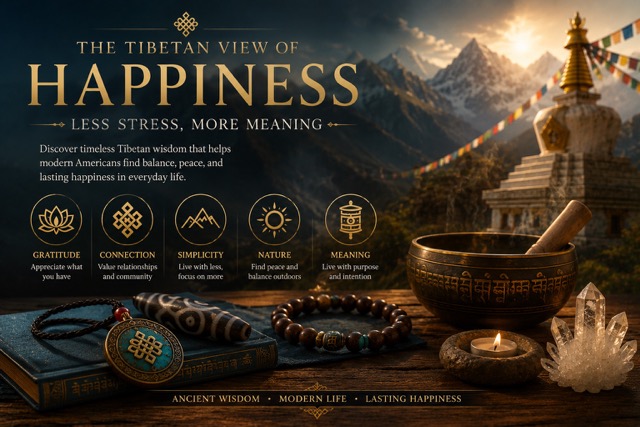
Are We Chasing the Wrong Definition of Happiness?
For generations, many people have been taught that happiness comes from achievement.
A better job.
A larger home.
A higher income.
More possessions.
More accomplishments.
The assumption is simple: if we keep moving forward, happiness will eventually arrive.
Yet in modern America, many people have more comfort and convenience than ever before, while still feeling overwhelmed, stressed, and disconnected.
This has led many to ask an important question:
What if happiness isn't something we achieve, but something we practice?
A Different Perspective From the Tibetan Plateau
High in the Himalayas, Tibetan communities have lived for centuries in one of the world's most challenging environments.
Life has never been easy.
Long winters, high altitudes, and limited resources have shaped a culture that values resilience, gratitude, and community.
While material wealth may be limited, visitors often notice something surprising:
Many people appear deeply content.
This doesn't mean life is free from hardship.
Rather, happiness is often viewed differently.
Instead of focusing solely on what is missing, people learn to appreciate what is already present.
The American Pursuit of "More"
Modern culture often encourages constant striving.
More productivity.
More success.
More possessions.
More goals.
While ambition can be valuable, it can also create a feeling that we are never enough.
Many Americans find themselves trapped in a cycle where every achievement quickly leads to the next challenge.
The result is a lifestyle that leaves little room for appreciation.
Instead of enjoying the present, people are always preparing for the future.
Gratitude as a Daily Practice
One of the most powerful lessons found in Tibetan traditions is the importance of gratitude.
Gratitude is not about ignoring problems.
It's about recognizing the good that exists alongside them.
Research continues to show that gratitude can improve emotional well-being, strengthen relationships, and reduce stress.
Simple practices include:
· Writing down three things you're thankful for
· Appreciating small moments
· Taking time to reflect on positive experiences
· Expressing appreciation to others
These habits may seem small, but their impact can be significant.
Happiness Through Connection
Another key aspect of Tibetan culture is the emphasis on relationships.
In many modern societies, success is often measured individually.
But happiness is rarely experienced alone.
Strong relationships with family, friends, and community continue to be among the strongest predictors of life satisfaction.
Many Tibetan traditions emphasize:
· Compassion
· Generosity
· Shared experiences
· Helping others
These values remind us that meaningful connections are often more valuable than material possessions.
Simplicity Creates Space
One reason many people feel overwhelmed is that modern life is filled with constant stimulation.
Notifications.
Advertisements.
Endless choices.
The Tibetan approach often emphasizes simplicity.
Not because owning less is automatically better, but because simplicity creates room for what matters most.
When we reduce unnecessary distractions, we often gain:
· More clarity
· More focus
· More peace
· More appreciation
In many ways, simplicity isn't about giving things up.
It's about making space for a richer life.
The Role of Nature in Well-Being
Tibetan culture has always maintained a deep connection with nature.
Mountains, rivers, grasslands, and open skies are not merely scenery.
They are part of daily life.
Modern research increasingly supports what traditional cultures have long understood:
Nature can help restore emotional balance.
Spending time outdoors has been linked to reduced stress, improved mood, and greater mental clarity.
For many Americans living in busy cities, reconnecting with nature can be one of the simplest ways to improve overall well-being.
Meaning Over Possessions
In recent years, many consumers have begun shifting away from buying more things and toward finding more meaning.
People are choosing products that reflect:
· Personal values
· Cultural appreciation
· Craftsmanship
· Authenticity
This trend reflects a broader realization:
The things we own are often less important than the meaning we attach to them.
A meaningful object can serve as a daily reminder of gratitude, growth, and intention.
Final Thoughts
The Tibetan view of happiness offers a simple but powerful lesson.
Happiness is not a destination waiting somewhere in the future.
It is found in the way we experience each day.
Through gratitude.
Through meaningful relationships.
Through simplicity.
Through connection with nature.
And through appreciating what we already have.
In a world that constantly encourages us to seek more, perhaps true happiness begins by noticing what is already enough.