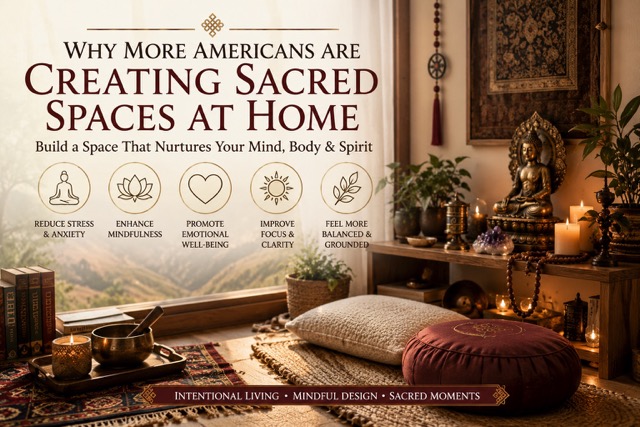
Home Means Something Different Today
A few decades ago, home was primarily seen as a place to eat, sleep, and spend time with family.
Today, home has become much more than that.
For millions of Americans, home is now also:
· An office
· A gym
· A place for self-care
· A retreat from daily stress
· A sanctuary for personal growth
As modern life becomes increasingly fast-paced and digitally connected, many people are realizing the importance of creating environments that support emotional well-being.
This is one reason why the concept of a "sacred space" has become increasingly popular across the United States.
What Is a Sacred Space?
A sacred space doesn't have to be religious.
It doesn't require a dedicated room.
And it certainly doesn't need to be elaborate.
A sacred space is simply a place that helps you reconnect with yourself.
It can be:
· A quiet reading corner
· A meditation area
· A comfortable chair near a window
· A small altar with meaningful objects
· A peaceful bedroom designed for rest
What matters isn't the size of the space.
What matters is the intention behind it.
In a world filled with constant distractions, sacred spaces provide an opportunity to pause and breathe.
Why Americans Need These Spaces More Than Ever
Modern American life is often defined by speed.
Notifications arrive every few minutes.
Work follows people home.
Social media creates constant comparison.
Many people feel mentally exhausted before the day even begins.
According to wellness experts, chronic stress has become one of the most common challenges facing modern adults.
As a result, people are actively seeking ways to create moments of calm.
This growing interest has fueled the popularity of:
· Meditation
· Yoga
· Journaling
· Mindfulness practices
· Intentional home design
People are no longer decorating solely for appearance.
They're decorating for how a space makes them feel.
Lessons From Tibetan Culture
For centuries, Tibetan culture has emphasized the importance of creating environments that support reflection, gratitude, and inner peace.
Life on the Tibetan Plateau has always required resilience.
Surrounded by vast mountains and open landscapes, people developed traditions that encourage mindfulness and connection with the present moment.
Many Tibetan homes traditionally include meaningful objects that serve as reminders of important values:
· Compassion
· Gratitude
· Wisdom
· Balance
· Respect for nature
These principles resonate strongly with many Americans who are seeking a healthier relationship with themselves and their environment.
The Power of Meaningful Objects
One of the biggest trends in modern home design is the move toward intentional décor.
Instead of filling homes with random decorations, people are choosing objects that carry personal meaning.
Examples include:
· Handmade crafts
· Natural crystals
· Artisan-made jewelry displays
· Singing bowls
· Cultural artwork
· Travel keepsakes
These objects help tell a story.
More importantly, they remind us of what matters most.
A crystal cluster on a desk may remind someone to slow down.
A handcrafted pendant may symbolize a personal goal.
A Tibetan-inspired piece may represent a commitment to mindfulness.
Objects become powerful when they carry meaning.
Creating a Peaceful Corner at Home
Building a sacred space doesn't require a large budget.
In fact, simplicity is often the goal.
Many people begin with a small area that includes:
Natural Elements
Plants, wood, stones, and natural materials help create a connection with nature.
Soft Lighting
Warm lighting encourages relaxation and reduces visual stress.
Meaningful Objects
Choose items that inspire calm, reflection, or gratitude.
Comfortable Seating
A place to sit quietly can encourage daily moments of mindfulness.
Reduced Clutter
A clear environment often supports a clearer mind.
Why This Trend Continues to Grow
The popularity of sacred spaces reflects a larger cultural shift.
People are beginning to understand that well-being is not something that happens accidentally.
It requires intention.
It requires boundaries.
It requires moments of stillness.
As Americans become more interested in mental wellness and mindful living, the demand for meaningful environments continues to grow.
Final Thoughts
The world outside may continue to move faster.
Technology may continue to demand our attention.
Life may continue to feel busy.
But inside our homes, we have the opportunity to create something different.
A space that encourages calm.
A space that supports reflection.
A space that reminds us to slow down and reconnect with ourselves.
Sometimes peace isn't found by traveling far away.
Sometimes it begins with a quiet corner at home.